Outreach & Community Engagement

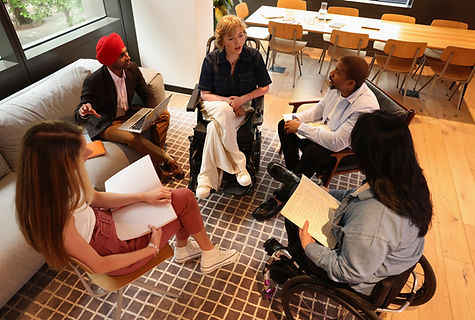
The Value of Outreach & Community Engagement

I am going to hit you with a statistic right here, and like it did for me, it might make you sad.
77% of people with disabilities do not participate in their community (The Library’s Role in Encouraging Positive Community Experiences for Disabled People, n.d.).
Whether or not you currently work with patrons who are disabled, or neurodiverse patrons, this statistic should be motivation enough to make changes at your library. As librarians, what can we do to encourage people with disabilities to visit our libraries? To start, we need to ensure that we are doing outreach to the appropriate people and groups and getting out there and engaging the community – letting them know about all the good things that happen at the library!
So where do we start? First, we need to understand that not “one size fits all” for this group of people. People who have visible physical disabilities may have different needs than students with hidden physical or behavioral disabilities. So no one kind of outreach or accommodation is going to work for everyone – make sure you think about the multiplicity of people with a disability you will be serving (Working With Patrons With Disabilities, n.d.).
The New Members Round Table (NMRT), a division of the American Library Association (ALA) has a great paper on this subject, called Working With Patrons With Disabilities: How Do I Get Started (Working With Patrons With Disabilities, n.d.). By the way, if you are new to librarianship, I highly recommend that you join the NMRT – they provide a wealth of information for new(er) librarians! In their paper, they provide several helpful tips:
-
Check Your Assumptions: Read and learn all you can about strategies for working with patrons with disabilities. Practice setting up the accessible software your library has to offer. And check your assumptions. Your experience with using the library and the tools within might be, and probably will be, different than the experiences that your patrons with disabilities will have. After getting some book-learning in, you’ll next want to…
-
Start Small: You may not have a ton of extra time to do a ton of extended outreach services. If you fall into this category, find out what tools or services your library has for patrons with disabilities. Does your library have tables or spaces for patrons with mobility devices? Does your library have accessible software on the computers? Educate yourself on the free accessibility tools available via Windows. And if your library has a patron advisory board, try to ensure that patrons with disabilities are involved with that. These patrons can provide valuable perspectives on how the library can better meet their needs.
-
Build A Training Plan: You will want to help your fellow staff members get up to speed. Organizations such as ALA’s Association of Specialized and Cooperative Library Agencies (ASCLA) offer advice, support, and education about working with patrons with disabilities. They also offer online classes that you and fellow staff can take advantage of! You will also want to create a guide (physical or online) that can be shared with staff on how to set up and use any accessible software so the guide can be consulted by staff when needed.
-
You will want to ensure that you and fellow staff start to use inclusive language when talking about disability. In general, people-first language is considered the most inclusive way to refer to people with disabilities (say “person with a disability” rather than “disabled person”). Using person-first language emphasizes the person above all and shows that disability is only one aspect of their life. Also, avoid terms that convey a negative tone, such as “confined to a wheelchair” or “suffers from a disability” – instead say “uses a wheelchair” or “has a disability” (Best Practices in Outreach | CELA, n.d.).
You will also want to make sure your meetings and programming are accessible. For in-person meetings, proactively invite participants to request any accommodation they require. The sooner you know about any accessibility requirements they may have, the easier they are to meet! If you are working with sign language interpreters, be prepared to share programming related documents (speaking notes, books for story time) in advance so they can prepare. Be sure to use microphones and ask that people identify themselves when they speak. For virtual programming, ensure the platform you are using has accessibility features. And remember that screen reader software cannot access documents being shared during screen share, so share those documents ahead of time and describe what part of the document you are sharing during your presentation (Best Practices in Outreach | CELA, n.d.).
Also, for library signage, rather than having signs that are a jumble of words, try incorporating infographics into your library signage! I have provided several examples of excellent library infographics in the sidebars, courtesy of Librarian Resources (“Communicate the Value of Your Academic Library,” n.d.), Ebook Friendly (“Why You Need a Librarian #infographic,” 2015), and TPT (Dewey Library Guide - 11 Posters and Bookmark, n.d.).
Regarding other library documents, such as flyers and brochures being used for your outreach efforts, utilized guidelines such as those provided by CNIB (Best Practices in Outreach | CELA, n.d.). These guidelines include:
-
Use high contrast colors for text and background (black or dark blue on white or yellow background for example).
-
Keep your text large, preferably between 12 and 18 points.
-
The space between lines of text is called “leading.” Your leading should be at least 25 to 30 percent of the font size – this helps readers move their eyes more easily to the next line of text.
-
Avoid complicated or decorative fonts – you want easily recognizable upper- and lower-case letters. Arial and Verdana are good fonts to consider.
-
Use bold font to emphasize a word or passage, instead of using italics or typing a word in upper case letters.
-
Separate text into columns to make it easy to read and use wide binding margins.
-
Use matte or non-glossy paper for your handouts.


So how do we reach our community members?
So now we feel prepared – or at least somewhat prepared – so now what do we do? How do we reach members of this community to let them know what is waiting for them at the library? The Association for Library Service to Children (ALSC) has some great recommendations on ways to connect with the disability community (Caregivers, 2024).
First, connect with your school district’s Special Education Team. You probably already do school visits, and if you have not already spoken with the special education staff there – do it! You will find that some students with disabilities are in general education classrooms, and some are in special education classrooms, so this is a good question to ask any teachers you work with in the school district. Also talk to the school’s library staff and find out how the school library has been supporting these students. Ask both the school librarian and the teachers what might be missing for these students. And be sure to contact the school district’s central office, or your county office of education. They may have a special education team that can tell you about bigger programs and initiatives beyond your nearby schools.
You will also want to connect with your nearest Early Intervention Provider. This is a federal program, administered by the states, which provides therapy and services to children with disabilities or delays from ages birth to three. In California, the Early Intervention Provider is Early Start (https://www.dds.ca.gov/services/early-start/), but if you live in another state you can find out who your Early Intervention Provider is on the Center for Disease Control website (https://www.cdc.gov/act-early/early-intervention/contact-information-by-state.html). These early intervention providers can be wonderful partners and resources for you, as they are extremely knowledgeable about families with very young children who have disabilities. Their staff can also point you towards other local nonprofits, disability-friendly preschools, and in-person support groups that may want to partner with you for outreach services such as off-site story times or book distribution.
Finally, be sure to look up and join/visit online support groups. These can often be found on Facebook, through parenting groups, or through the local PTA association. These groups can help you answer questions such as what days would be good for programming, or what barriers families encounter when they try to come to the library. Just remember to identify yourself in the group as a representative of the library, and people will usually be receptive to helping you out by completing surveys or participating in focus groups.
What other partnerships would benefit my patrons with disabilities and neurodiverse patrons?
Partnerships can be extremely valuable in spreading awareness of the accessibility work you have done at your library! For older adults with disabilities, try partnering with local senior centers and assisted living facilities. Centers for Independent Living can also share information about library initiatives with people who are within the library’s service area. If your target audience is children with disabilities or neurodiverse children, as we discussed above – get out to those schools and Early Intervention Providers! Government agencies can also assist with your outreach efforts. Find those governmental divisions related to disability, aging, and social services at the town or county level. These agencies will help you find new ways to increase awareness of your accessibility projects!
You will also want to form partnerships with:
-
Local chapters of national disability-focused nonprofits, like ARC and Easter Seals.
-
Meal Delivery Services for people with disabilities.
-
Day Programs for people with disabilities.
-
Healthcare organizations.
These partnerships will help you get the word out about your new library programs. They may also offer you spaces, resources, personnel, and/or funding to help make your programs possible. Many of the staff at these organizations might be willing to also share their expertise by being guest speakers or workshop leaders at your programming (Partnering for Accessibility in Small & Rural Libraries | Programming Librarian, 2024)! But it all starts with you getting out there, making those connections, and talking to people. Get out there and do it – and have fun!
Picture Credits: Sidebar pictures cited in-text. Header and Footer pictures courtesy of iStock.